
Latest Resources
Explore the Resource Library
Browse practical resources by topic.
Why More Plumbing Contractors Should Be Looking at Hydrovac
Plumbing contractors don’t have to own a hydrovac to put one to work. Here’s where subcontracted hydrovac excavation can save crew time, expand underground capabilities, and make sense without adding another piece of specialized equipment.
Below the Surface | Artisan Group
There’s an opportunity right beneath your feet.
Plumbing contractors know how to repair the water main, replace the sewer line, or make the underground connection. The problem is that getting to the plumbing can turn a relatively straightforward job into an excavation project. Sometimes that means tying up a crew and equipment on a small dig. Other times, it means hours of careful excavation around existing utilities, difficult access, or working through Southern Utah’s summer heat.
Your crew may be perfectly capable of handling the excavation. That doesn’t necessarily mean it is the best use of their time or resources.
Hydrovac gives plumbing contractors another option. Instead of owning another specialized piece of equipment or committing a crew to a dig that is consuming the job, you can bring in hydrovac for the excavation that calls for it, get the pipe exposed, and move your crew into the plumbing work.
You don’t have to own the machine to put it to work.
Stop Treating Every Underground Job Like a Trenching Job
An excavator is built to move dirt efficiently. Hydrovac uses pressurized water to loosen soil and a vacuum to remove the material, allowing more controlled excavation around buried infrastructure.
That makes it particularly useful when a contractor needs to expose a water main, locate a sewer connection, verify a utility crossing, or remove soil around existing pipes and conduits. It can also provide working room around an underground repair without requiring the same approach used to open an entire trench.
Hydrovac is not a replacement for an excavator, and treating it that way misses the point. Conventional equipment remains the right choice for bulk excavation on many projects. Hydrovac becomes useful when the excavation reaches the point where targeted exposure and greater control matter more than moving a large volume of material.
On the same project, there may be a place for both.
The Locate Marks Don’t Tell You Everything
A painted line on the ground is not a verified utility depth.
Before crossing an existing facility, a contractor may need to establish where it actually sits underground. Utility daylighting, sometimes called potholing, creates a targeted excavation that allows the facility’s location and depth to be physically verified before the larger excavation continues.
Utah’s excavation procedures require additional precautions when working near marked underground facilities.[1] OSHA also recognizes appropriately adjusted hydro vacuum equipment as an acceptable means of locating underground installations under specified conditions.[2]
Hydrovac is not damage proof. Water pressure, operating technique, utility condition, soil conditions, and the type of facility being exposed still matter. It does, however, give a contractor a way to uncover existing infrastructure and gather information that surface markings alone cannot provide.
That information can change how the rest of the project proceeds. Knowing the actual depth and position of an existing line can affect trench alignment, elevation, clearance, equipment selection, and the sequence of work before a larger excavation is opened.
When the Dig Isn’t Worth Tying Up Your Crew
Not every underground repair warrants committing your own crew and equipment to hours of excavation.
Sometimes it is a relatively small exposure in a difficult location. Sometimes the crew is carefully working around existing infrastructure. Sometimes Southern Utah weather makes an otherwise simple hand excavation a much more demanding part of the day. In other cases, the excavation is simply taking longer than the plumbing work it was supposed to support.
That does not mean your crew cannot handle it. The better question is whether they should.
Bringing in hydrovac for targeted excavation can get the line exposed and establish the working room your plumbers need so they can move into the repair or installation. On the right project, it keeps a relatively small excavation from consuming the schedule and resources of the larger plumbing job.
Hand digging will always have its place, and hydrovac will not make every excavation faster or easier. The opportunity is recognizing when the excavation has become a disproportionate part of the job and bringing in specialized equipment to handle it.
Hydrovac Capability Without Hydrovac Ownership
This is where the business case becomes more interesting for plumbing contractors.
Buying a hydrovac is only the beginning of the investment. Once you account for a purchase or lease payment, insurance, maintenance, repairs, storage, a suitable tow vehicle for trailer mounted equipment, operator requirements, water supply, slurry handling and downtime, ownership can be difficult to justify for a company that only needs the equipment periodically.
Depending on the vehicle combination and how it is operated, commercial transportation requirements can add another layer of registration and compliance.[3] Then there is the simplest equipment problem of all: when your machine is down, it is your problem to solve.
For a contractor using hydrovac every day, those costs may make sense. For a plumbing company that encounters the right application a few times a month, or only on certain types of underground projects, the economics can look very different.
That does not mean you need to pass on work that would benefit from hydrovac.
A plumbing contractor can estimate the complete project, subcontract the specialized excavation, and retain the plumbing scope. When the project is priced correctly, the subcontracted excavation can be incorporated into the overall job while leaving room for the contractor’s coordination, project responsibility, overhead, and intended margin. Profitability is not automatic, but neither is equipment ownership a prerequisite for offering the capability.
The better question is not, “Should we buy a hydrovac?” It may be, “How often do we actually need one, and what is the most profitable way to have access to it when we do?”
Look at the Job Cost, Not Just the Equipment Rate
Hydrovac can carry a higher hourly equipment rate than other excavation methods. Looking at that number by itself does not tell you which approach will produce the best result for the project.
A contractor should look at the complete operation. How long will the excavation take? How many people will it occupy? What equipment needs to be mobilized? Can an excavator handle the bulk work while hydrovac handles the utility exposure? What are the material handling and disposal requirements? How quickly can the plumbing crew move into its scope once the excavation is complete?
There will be plenty of jobs where conventional excavation makes more sense. A small dig in open ground may not justify specialized equipment, while dense caliche or rock can make hydrovac inefficient or unsuitable for portions of a project.
There are other jobs where a relatively small excavation is holding up an otherwise productive plumbing crew. In those cases, the relevant comparison is not simply the hourly rate of one machine against another. It is the cost and operational impact of completing that portion of the project using each available method.
The right excavation method should support the economics of the entire job.
Working With an Excavation Contractor Who Understands Plumbing
Subcontracting the excavation only works well if the excavation crew understands what your plumbers need when the digging is finished.
A pipe being visible is not necessarily the same as a pipe being ready to work on. Your crew may need clearance beneath the line, room for a coupling, access to a connection, or enough exposed pipe to remove and replace a damaged section. The location and shape of the excavation can affect whether the plumbing crew can actually perform the work efficiently once they arrive.
Those details are easier to address before excavation begins than after the equipment has left the site.
This is where Artisan Group is different from a hydrovac operator that only sees the excavation scope. Artisan operates full service plumbing and excavation divisions alongside our hydrovac equipment. We understand what it takes to expose the pipe, but we also understand what the plumber needs to do next.
When another plumbing contractor hires Artisan for hydrovac or excavation support, we are not there to take over the plumbing job or the customer relationship. Our job is to understand your scope, coordinate with your crew, and perform the excavation with the work that follows in mind.
Tell us what you are repairing or installing, what needs to be exposed, and what your guys need to complete the work. We can provide hydrovac as a standalone service, combine it with conventional excavation when the project calls for both, and then hand the site back to your crew for the plumbing work.
Having full service plumbing and excavation divisions gives us an understanding of both sides of that handoff. We know why the excavation matters because our own plumbers work on the other side of it.
For plumbing contractors, that creates a straightforward opportunity: take on the right underground work, bring in specialized excavation when it makes sense, and keep your own people focused where they are most productive.
You handle the plumbing. We understand what you need from the excavation.
Need Hydrovac Support on an Underground Project?
Artisan Group provides hydrovac excavation for plumbing contractors and other trades throughout St. George, Washington, Hurricane, Ivins, Santa Clara, and surrounding Washington County communities.
If you have a project that requires utility exposure, potholing, targeted excavation, or a combination of hydrovac and conventional excavation, send us the project location, scope, and anticipated schedule. We can look at what needs to be exposed and determine whether hydrovac is the right fit for that portion of the job.
Explore Our Hydrovac Excavation Services →
Sources
1. Blue Stakes of Utah 811. Excavator’s Guide. Utah utility marking, tolerance zone, and excavation procedures.
2. Occupational Safety and Health Administration. Use of Hydro Vacuum Excavation Equipment and Other Acceptable Means to Locate Underground Utility Installations. October 23, 2003.
3. Federal Motor Carrier Safety Administration. Do I Need a USDOT Number? Commercial vehicle requirements vary based on vehicle configuration, weight, operation, and jurisdiction.
What’s in Southern Utah’s Drinking Water? Local Test Results Explained.
What do local drinking water tests reveal? Explore Southern Utah's arsenic, fluoride, chlorine and mineral levels, compared with federal standards and health guidelines.
Southern Utah's drinking water contains more than just minerals. Public testing in Washington County documents arsenic, fluoride, dissolved solids, and substances formed during water treatment.
We compared local water quality reports with EPA standards, national data, and Environmental Working Group (EWG) health guidelines to see what the results actually mean.
KEY TAKEAWAY
Southern Utah's reported water quality varies by source and municipality. Water can meet federal drinking water standards while still containing measurable substances that homeowners may prefer to filter.
St. George's historical arsenic average, for example, was substantially higher than the national utility average, even though the reported average was below the federal limit. [3]
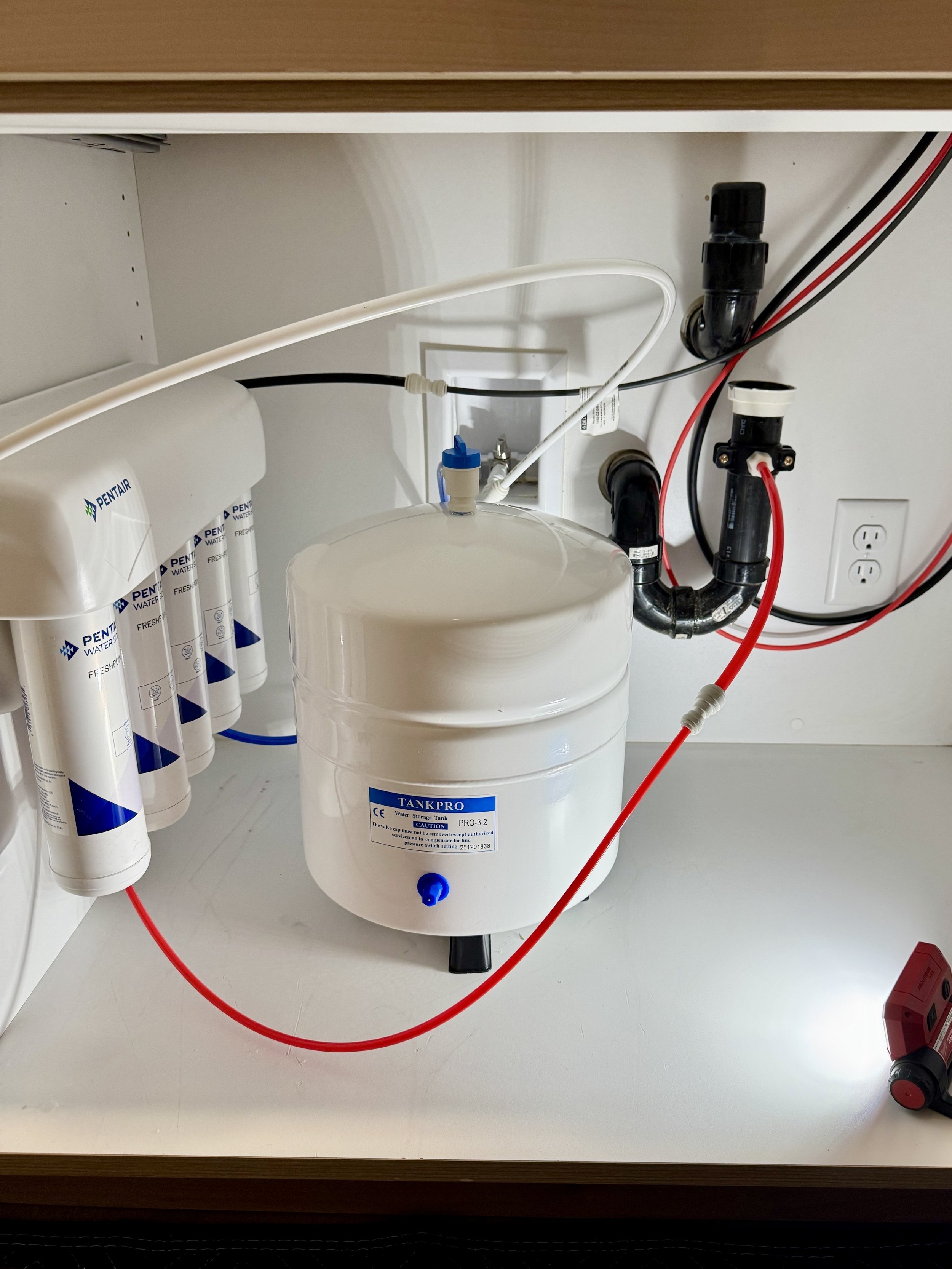
Pentair reverse osmosis drinking water system installed by Artisan Plumbing in Southern Utah.
What Do Washington County Drinking Water Reports Show?
The 2025 reports from Washington City and Ivins provide a snapshot of several commonly discussed drinking water contaminants.
Arsenic
Washington City: 1.3–3.8 ppb
Ivins: 1.0–8.5 ppb, reported as running annual averages
EPA limit: 10 ppb
Fluoride
Washington City: 0.028–0.253 ppm
Ivins: Not detected to 2.12 ppm
EPA primary limit: 4 ppm
Total Dissolved Solids
Washington City: 210–656 ppm
Ivins: 118–936 ppm
EPA secondary guideline: 500 ppm
Total Trihalomethanes
Washington City: 5–48 ppb
Ivins: 5.9–12.6 ppb
EPA limit: 80 ppb
Sources: Municipal water quality reports and EPA standards. [1, 2, 5]
These results combine measurements from different water sources and sampling locations. They do not represent the exact water quality at every household faucet.
Arsenic: How Does Southern Utah Compare?
Arsenic occurs naturally in some groundwater. Several local supplies use treatment or blending to reduce concentrations before water reaches customers. [2]
EWG's historical data provides a national comparison for 2021–2023:
St. George: 9.58 ppb
Washington City: 2.02 ppb
National utility average: 0.624 ppb
EPA legal limit: 10 ppb
EWG health guideline: 0.004 ppb
Sources: EWG and EPA. [3, 4, 5]
St. George's reported historical average was substantially higher than EWG's national utility average.
Why is EWG's guideline so much lower than EPA's limit?
EPA's enforceable standards consider health risks and treatment feasibility. EWG uses additional health-based benchmarks, including California's public health goal for arsenic.
Exceeding an EWG guideline does not automatically indicate a federal drinking water violation. [3, 5]
These comparisons reflect historical utility data, not current measurements at individual homes.
Dissolved Minerals and Hard Water
Southern Utah's mineral content is a familiar issue for homeowners.
Total dissolved solids (TDS) measure minerals, salts, and other dissolved material. Higher concentrations can affect taste and contribute to mineral deposits.
Washington City and Ivins both reported source measurements above EPA's 500 ppm secondary guideline. That guideline primarily addresses aesthetic concerns rather than a specific health risk. [1, 2, 5]
TDS alone does not indicate whether water is safe or unsafe.
Water hardness is a separate measurement associated primarily with calcium and magnesium. A water softener addresses hardness, while drinking water filtration can reduce additional dissolved substances.
Chlorine and Disinfection Byproducts
Chlorine is used to control harmful microorganisms in public drinking water.
Ivins reported chlorine concentrations of 0.1–0.4 ppm in 2025, below EPA's maximum residual disinfectant level of 4 ppm. [2, 5]
However, chlorine and other disinfectants can react with naturally occurring material in water, forming disinfection byproducts.
One group, total trihalomethanes (TTHMs), has an EPA limit of 80 ppb.
EWG's historical comparison shows:
St. George average: 35.4 ppb
National utility average: 29.1 ppb
EWG health guideline: 0.15 ppb
These figures reflect 2021–2023 testing. [3]
Disinfection serves an important public health purpose. Some homeowners nevertheless choose additional filtration for the water they drink.
Is Fluoride Added to Southern Utah's Water?
Utah prohibited adding fluoride to public drinking water beginning May 7, 2025. [6]
Fluoride can still occur naturally in groundwater.
Ivins City confirms that it does not add fluoride. Its 2025 report includes source measurements reaching 2.12 ppm. [2]
EPA's primary fluoride limit is 4 ppm, while its secondary threshold is 2 ppm.
The city's reported maximum does not mean every home receives water at that concentration. [2, 5]
PFAS and Microplastics: What Do We Know?
PFAS, often called forever chemicals, are manufactured compounds found in various consumer and industrial products.
Ivins participated in EPA's national monitoring program in 2024. Its report states that none of the 29 PFAS compounds tested were detected. Lithium was detected at concentrations reaching 180 ppb. [2]
A nondetection means a substance was not detected above the applicable reporting threshold. It does not necessarily establish absolute zero.
Microplastics remain a testing gap.
We did not identify published quantitative microplastics measurements in the municipal reports examined.
EPA's 2023–2025 national monitoring program covered 29 PFAS compounds and lithium, not microplastics. [7]
The available reports therefore cannot establish whether microplastics are present or absent in local drinking water.
What Can Southern Utah Homeowners Do?
Municipal reports provide valuable information, but they cannot establish the exact contaminant concentrations at an individual household faucet.
Homeowners can identify their water supplier, review its latest testing results, and consider testing their own drinking water.
For those interested in additional filtration, a properly selected reverse osmosis system can reduce specific contaminants and dissolved substances. The reduction capabilities depend on the system's certification and performance. [8, 9]
Reverse osmosis can supply filtered water for drinking, cooking, refrigerator dispensers, and ice makers, depending on the system's capacity and plumbing configuration.
Understanding your water gives you the information needed to decide whether additional filtration makes sense for your home.
Sources and Research Methodology
This article was researched by Artisan Plumbing using municipal drinking water reports, EPA regulations, and EWG's Tap Water Database.
Municipal comparisons use verified 2025 testing from Washington City and Ivins. St. George's national comparisons use historical 2021–2023 data.
[1] Washington City — 2025 Annual Drinking Water Quality Report
https://washingtonutah.gov/publicworks/water/ccr/CCR2025.pdf
[2] Ivins City — 2025 Water Quality Report, published June 2026
https://ivinsutah.gov/reports-studies/
Select the 2026 Water Quality Report.
[3] Environmental Working Group — St. George City Water System
https://www.ewg.org/tapwater/system.php?pws=UTAH27015
[4] Environmental Working Group — Washington City Water System
https://www.ewg.org/tapwater/system.php?pws=UTAH27021
[5] U.S. EPA — Drinking Water Regulations and Contaminants
https://www.epa.gov/sdwa/drinking-water-regulations-and-contaminants
[6] Utah Department of Environmental Quality — Fluoride in Utah's Drinking Water
https://deq.utah.gov/drinking-water/fluoride-drinking-water
[7] U.S. EPA — Fifth Unregulated Contaminant Monitoring Rule
https://www.epa.gov/dwucmr/fifth-unregulated-contaminant-monitoring-rule
[8] NSF — Reverse Osmosis Drinking Water Treatment Systems
https://www.nsf.org/knowledge-library/nsf-ansi-58-reverse-osmosis-drinking-water-treatment-systems
[9] U.S. EPA — Point-of-Use Reverse Osmosis Systems
https://www.epa.gov/watersense/point-use-reverse-osmosis-systems
Research note: Results may reflect different water sources and sampling locations. This article does not establish contaminant concentrations at individual addresses. Unresolved Hurricane arsenic measurements and unverified newer St. George measurements have been excluded.
Last reviewed: September 2026.