
Water & Sewer Line Services
St. George & Southern Utah
Repair • Replacement • New Installation • Excavation
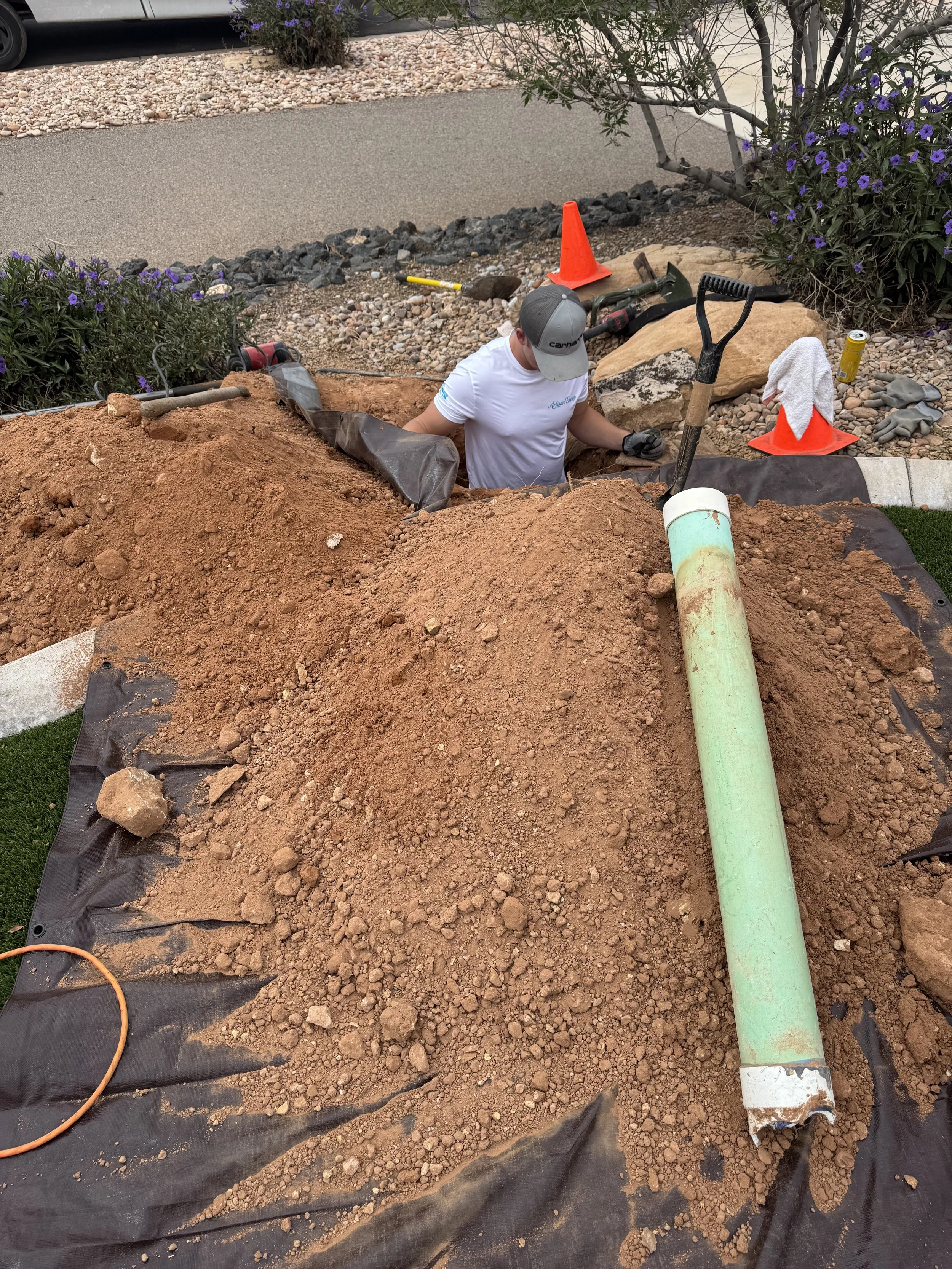
Underground water and sewer line repair requires more than repairing the pipe itself. Before a plumber can make the connection, the line has to be located and safely reached. The excavation needs to provide the right access and working room, sewer lines have to maintain the proper grade, the pipe needs suitable support, and once the plumbing work is complete, the excavation has to be backfilled with the finished site in mind.
Artisan Group brings those responsibilities together. Our plumbing service department has direct access to our own excavation operation, including conventional excavation equipment, hydrovac, material handling, hauling, and the support equipment needed for underground utility work. When a service call turns into a buried water or sewer problem, we are not starting from scratch trying to locate another contractor with the equipment to reach it.
That capability changes how we can approach the entire project. Our plumbers and excavation team can plan access together, daylight existing utilities where additional information is needed, choose the appropriate excavation method for the site, complete the plumbing repair, and coordinate backfill and the agreed restoration scope through one operation.
Artisan provides water service and sewer line repair, replacement, and new installation for residential, commercial, and multifamily properties throughout St. George and Washington County.
What do you need help with?
If you are not sure where the problem is located, that is normal. Symptoms above ground often provide only part of the information. The location of the line, previous repairs, changes in water use or drainage, site access, existing utilities, and conditions around the property all help determine where the investigation should begin.
Plumbing and Excavation Need to Work Together
A buried pipe can be repaired correctly at the fitting and still be part of a poorly executed underground project.
The excavation determines whether the plumber has enough room to make the repair properly. Sewer work depends on maintaining the required elevations and grade. Existing utilities affect where equipment can operate and how a trench can be opened. The pipe needs appropriate support before the excavation is closed, and the material placed back around it affects both the utility and the finished surface above.
This is where underground plumbing can become difficult when the work is divided between unrelated trades. An excavation contractor can expose a line without necessarily knowing how much pipe the plumber needs uncovered, where clearance is needed beneath a connection, or which elevations have to be preserved. A plumber may understand exactly how the piping should be repaired but have limited control over how it is accessed, how much working room is created, or what happens to the excavation afterward.
Artisan performs both scopes. Our excavation team understands that the objective is not simply to uncover a pipe. The objective is to create the conditions necessary to complete the plumbing correctly and then leave the line properly supported when the ground is closed again.
That coordination matters because much of the quality of an underground utility project becomes invisible once the excavation is backfilled.
Water Line Repair & Replacement
A buried water service, often called the main water line by homeowners, can fail in several ways. Some leaks create obvious surface water, while others first appear as unexplained water use, a meter that continues moving when fixtures are off, a sudden change in pressure, persistently wet ground, or a water bill that no longer makes sense.
Those symptoms do not automatically prove that the underground service is leaking. Irrigation, exterior plumbing, interior leaks, and other water use can create similar clues, so determining whether the buried line is actually the problem comes before deciding how much ground needs to be opened.
When the water service does need repair, we look at the location of the failure, pipe material and condition, previous repairs, accessibility, nearby utilities, and the surfaces above the line. A localized failure in an otherwise serviceable line may justify a targeted repair. Repeated failures or deterioration along the service may make replacing a larger portion more practical.
Because the excavation and plumbing are both available through Artisan, the project can move from locating and accessing the line to completing the repair and backfilling the excavation without requiring the property owner to coordinate separate contractors for each stage.
Sewer Line Repair & Replacement
A sewer backup does not automatically mean the underground sewer line is broken.
Multiple slow fixtures, recurring mainline problems, sewage odors, unusual drainage behavior, or backups at low points in the plumbing can indicate a problem somewhere in the building sewer, but a blockage and a damaged underground pipe require very different solutions. Excavation should be based on evidence that the line actually needs repair or replacement, not simply on the fact that wastewater is not moving correctly.
When a sewer problem appears to be in the underground building sewer or sewer lateral, camera inspection and locating become important parts of the diagnosis. A sewer camera can help identify what is happening inside the pipe, including obstructions, damaged sections, offsets, root intrusion, or other visible defects. Locating equipment can then help establish where that problem is positioned below grade so the repair can be planned around the actual location of the failure rather than opening unnecessary ground.
That information matters before excavation begins. Knowing where the defect is located, how deep the line is, how the sewer is routed, and where other utilities may cross it can affect the size and position of the excavation, the equipment selected, and whether a targeted repair or a larger replacement makes more sense.
Once excavation is required, the plumbing and excavation still have to work together. Gravity sewer piping depends on the relationship between elevation, slope, alignment, connections, and pipe support. Opening a trench without accounting for those conditions can make the plumber’s work harder or create problems after the line is covered again.
Our excavation and plumbing teams can coordinate how much line needs to be exposed, the working space required around the repair, and the elevations that need to be maintained. Once the piping is repaired or replaced, the line can be supported and the excavation backfilled according to the project requirements.
That is a fundamentally different approach from treating digging as a separate task that starts before the sewer problem has been properly located.
Daylighting Before Larger Excavation
Utility markings provide important information about where underground infrastructure is expected to be. They do not tell us everything that may matter once excavation begins.
The actual depth of a utility, how it changes direction underground, its relationship to another line, or the clearance available at a crossing may need to be physically verified before larger equipment moves into the area. That process is commonly called utility daylighting or potholing.
Hydrovac allows us to make small, controlled excavations at selected locations so buried utilities can be physically exposed and their actual position verified. On a developed property where water, sewer, gas, electrical, communications, and irrigation may occupy the same corridor, that information can materially change how the rest of the excavation is approached.
Daylighting can help establish the actual horizontal and vertical location of an existing utility, verify a crossing, identify available clearance, or show where conventional excavation can proceed more efficiently. Instead of committing to a larger trench based only on what can be seen from the surface, we can gather more information about what is actually in the ground first.
The important difference for Artisan is that hydrovac is not something our plumbing department has to source from another company every time it becomes useful. It is part of the excavation capability already available to support our own service work.
Hydrovac Changes What We Can Do Before We Dig
Hydrovac is valuable because it gives us another excavation option, not because every water or sewer project should be vacuum excavated from beginning to end.
Conventional excavation remains the efficient choice when there is adequate access and larger volumes of material need to be moved. Hydrovac becomes particularly useful where we want more control around existing infrastructure, where a crossing needs to be verified, or where a targeted portion of the project should be exposed before conventional equipment proceeds.
Many underground projects benefit from both methods. We may daylight existing utilities first, establish what is actually below grade, and then use conventional equipment for the larger excavation. On another project, hydrovac may be appropriate only around the line being repaired or at a sensitive crossing. Where open access and uncomplicated conditions exist, conventional excavation may be appropriate for nearly the entire job.
Because Artisan has access to both methods, we are not forced to choose the excavation approach based on whichever machine happens to be available from an outside subcontractor. The site, the buried infrastructure, the ground conditions, and the plumbing repair determine the approach.
Our Resource Library also goes deeper into how hydrovac supports plumbing work and why the excavation needs to be planned around the working space the plumber will actually need.
An Excavation Operation Behind the Plumbing Service Department
A conventional plumbing van can handle a significant amount of repair work, but it cannot excavate a failed water service, daylight a utility crossing, remove large quantities of material, haul spoils, or support a larger underground repair. When a typical plumbing service call extends below grade, the project can quickly become dependent on another company.
Artisan Group was built with broader field capability.
Our plumbing service department can draw on the excavation resources already within the company, including hydrovac, excavators, compact excavation equipment, material handling, hauling, and project support equipment. We can scale the equipment to the actual problem instead of approaching every underground service call with the limitations of a plumbing truck.
For the customer, the value is not the equipment list itself. It is what having that equipment available allows us to do: investigate the site more effectively, mobilize the appropriate resources, reduce unnecessary handoffs between trades, and maintain responsibility for both the plumbing repair and the excavation required to complete it.
Southern Utah Underground Conditions
Ground conditions throughout Washington County can vary considerably between properties and even within the same excavation. A project may involve loose desert soil, imported fill, clay, compacted material, caliche, rock, or areas that have already been disturbed by previous utility work.
Developed properties add another layer. Water, sewer, gas, electrical, communications, irrigation, and other infrastructure may occupy the same portion of the site.
Those conditions affect more than how quickly a hole can be dug. They influence equipment selection, access, utility exposure, trench geometry, pipe support, material handling, backfill, and how the site needs to be managed while the line is open.
Daylighting selected utilities before larger excavation can provide information that surface markings alone cannot, particularly where several services cross or run closely together. Once those conditions are understood, we can choose the equipment and excavation approach that makes sense for that portion of the project.
Hydrovac is not automatically the right answer in every Southern Utah soil condition. Cemented material, solid rock, or areas where water should be minimized can make conventional or mechanical excavation more practical.
The advantage is having options.
Repair or Replace the Line?
A localized failure does not automatically justify replacing an entire water or sewer service.
If the surrounding pipe is in reasonable condition and the problem is isolated, a repair may be the most practical choice. Replacement becomes more worth considering when failures are recurring, the material is deteriorating, previous repairs are accumulating, or repeated excavation is becoming an expensive way to postpone a larger correction.
We consider the condition and material of the pipe, location of the failure, repair history, accessibility, surrounding utilities, site conditions, and the excavation required for either option.
The excavation itself can materially affect that decision. Repairing a line beneath an easily accessible landscaped area is different from repeatedly mobilizing equipment into a difficult location, navigating multiple utility crossings, or reopening an improved surface.
Our objective is not to turn every underground leak into a replacement project. It is to make the repair decision with an understanding of both the pipe and what it takes to reach it.
Urgent Water & Sewer Line Failures
An underground line failure can quickly become more than a plumbing repair.
A failed water service may require the water to be controlled, the problem located, existing utilities identified, equipment mobilized, the line exposed, the plumbing repaired, and the excavation backfilled. Each step affects how quickly the property can return to normal use.
When the plumber has to locate an excavation contractor after the failure occurs, or the excavation company has to find a plumber after the line has been exposed, the response depends on several companies becoming available at the same time.
Artisan is structured differently. Our service department already has access to the excavation and support resources within Artisan Group, allowing us to evaluate an urgent underground failure as a complete project from the beginning.
That does not mean every emergency can be excavated immediately. Utility locating requirements, current availability, access, site conditions, and the nature of the failure still determine what can happen and when. It does mean that mobilizing excavation, hydrovac, hauling, or other support equipment does not automatically require introducing another contractor into the job.
If water is actively escaping, control the water if you know how to do so safely and contact us with the property location and what you are seeing. Photos of the affected area and information about the meter or main shutoff can also help us understand the situation.
New Water & Sewer Line Installation
Water and sewer work is not limited to repairs.
Artisan installs new underground water services and sewer laterals for residential, commercial, multifamily, renovation, and site development projects. That may involve a completely new service, relocation of existing infrastructure, replacement during a larger renovation, or extending utilities to support another portion of a property.
New installation requires coordination between the plumbing system and the site from the beginning. Connection points, elevations, route, existing utilities, access, inspections, future improvements, and the surfaces that will eventually sit above the line can all influence how the utility should be installed.
Because plumbing, excavation, and construction experience are available within Artisan Group, underground utilities can be considered as part of the larger property instead of as isolated trenches.
Commercial, Multifamily & Contractor Utility Work
Commercial and multifamily utility projects often require more coordination than a typical residential repair. Longer runs, multiple connections, existing improvements, utility crossings, staging limitations, inspections, schedule requirements, and several trades working within the same site can all affect the underground scope.
Artisan Group can provide plumbing and excavation together or support another contractor with the portion of the underground work they need.
General contractors and property owners can engage Artisan for a coordinated water or sewer scope. Plumbing contractors can also use Artisan specifically for daylighting, hydrovac, or conventional excavation while retaining their own plumbing work and client relationship.
Because our excavation team works alongside plumbers, we understand that the goal is not simply to make the utility visible. The excavation has to provide the trade completing the next step with enough working room, access, elevation control, and site management to perform its work properly.
Backfill, Support & What Happens After the Repair
An underground repair is not complete when the new fitting or section of pipe is installed.
Before the excavation is closed, the completed plumbing needs to be verified and the line supported appropriately for the application. The excavation then needs to be backfilled with consideration for both the utility and the surface that will eventually sit above it.
The appropriate approach depends on the utility, depth, site conditions, soil, project requirements, and finished surface. A landscaped area, driveway, roadway, building pad, and future concrete area do not necessarily have the same requirements.
This is another reason excavation experience matters on plumbing work. Once the project is complete, most of the work disappears from view, but the soil around the line continues to affect both the utility and the surface above it.
We define the restoration scope before the project moves forward so the client understands whether Artisan is returning the excavation to grade, preparing it for another contractor, or coordinating additional restoration as part of the project.
What to Expect From an Artisan Water or Sewer Project
Underground utility work begins with understanding both the plumbing issue and the property around it. We review what is happening, where the affected line is believed to run, site access, existing improvements, known utilities, and what may be required to safely reach the line.
From there, we determine the appropriate scope and excavation approach. Daylighting may be used where existing utilities or crossings need to be physically verified. Conventional excavation can then be used where it provides the most efficient access, with hydrovac remaining available for the portions of the work that benefit from additional control.
If a targeted plumbing repair makes sense, the excavation is planned around the room required to complete that repair properly. If replacement is the better option, we evaluate the larger route rather than looking only at the failed location.
The plumbing, excavation, equipment, and site work are coordinated through Artisan rather than being treated as unrelated phases.
For the customer, that means one company understands how the project needs to get from the surface, to the pipe, and back again.
Artisan Quality | Exceptional Client Experience.
Frequently Asked Questions
How do I know if my underground water line is leaking?
Possible signs include unexplained water use, a meter that continues moving when fixtures are off, a sudden pressure change, wet ground, surfacing water, or an unusual increase in the water bill. Those symptoms can have other causes, so the source should be investigated before assuming the buried service requires excavation.
Does every water line leak require replacement?
No. A localized failure in an otherwise serviceable line may be appropriate to repair. Replacement becomes more worth considering when failures are recurring, pipe condition is poor, or repeated excavation and repairs no longer make practical sense.
Does a sewer backup mean my sewer line is broken?
No. A blockage and a damaged sewer line can create similar symptoms. Sewer repair or excavation should be based on evidence that the underground line actually requires repair or replacement.
Why are sewer cameras and locating important before excavation?
A sewer camera helps identify what is happening inside the pipe, while locating equipment helps determine where that condition is positioned below ground. Together, they can help narrow the repair area, reduce unnecessary excavation, and provide better information for deciding whether the line should be repaired or replaced.
What can a sewer camera inspection show?
Depending on access and pipe condition, a sewer camera can help identify visible obstructions, damaged sections, offsets, root intrusion, or other defects inside the line. The camera inspection gives us better information about the condition of the sewer before deciding whether excavation is necessary.
What is utility daylighting?
Utility daylighting, sometimes called potholing, means physically exposing a small section of a buried utility so its actual location and depth can be verified. Hydrovac is commonly used for targeted daylighting because it can remove soil around selected areas without relying solely on mechanical excavation immediately adjacent to the utility.
Why does daylighting matter before excavation?
Surface markings identify the approximate location of utilities, but they do not necessarily show exact depth, configuration, or the relationship between multiple buried lines. Daylighting can provide that additional information before a larger excavation is opened.
Why does sewer grade matter?
Most building sewers move wastewater by gravity. The pipe therefore needs appropriate slope, elevation, alignment, and support. A repair that changes the grade or allows a section of the line to settle can create future drainage problems even when the pipe itself remains intact.
Can Artisan handle both the excavation and the plumbing?
Yes. Artisan Group operates plumbing and excavation within the same company and maintains hydrovac, conventional excavation, hauling, and supporting equipment for underground utility work.
Do you use hydrovac for every water and sewer project?
No. Hydrovac is particularly useful for daylighting, potholing, utility exposure, crossings, and targeted excavation. Conventional excavation is more efficient for many larger portions of underground projects. We can use either method or combine them depending on the site.
Do you handle urgent water line breaks?
Yes, based on availability, utility locating requirements, and site conditions. Our plumbing department has direct access to Artisan's excavation and support equipment, allowing us to evaluate the entire underground repair without automatically requiring the property owner to coordinate another contractor.
Do you install new water and sewer services?
Yes. Artisan installs new water services and sewer laterals for residential, commercial, multifamily, renovation, and site utility projects.
Will you restore the area after excavation?
Backfill and the agreed excavation restoration are defined as part of the project scope. Final landscaping, concrete, asphalt, or other finished surface work depends on the project and should be established before work begins.
Do you provide hydrovac or excavation for other plumbers?
Yes. Artisan's excavation and hydrovac capabilities are available as standalone subcontracted services. Another plumbing company can retain its own client and plumbing scope while Artisan provides the requested daylighting or excavation support.
Water & Sewer Line Service Throughout Washington County
Artisan Group provides water and sewer line repair, replacement, installation, daylighting, hydrovac, and excavation throughout St. George, Washington, Hurricane, Ivins, Santa Clara, and surrounding Washington County communities.
For a homeowner, that may mean diagnosing and repairing a leaking main water line or replacing a failed sewer lateral. For a contractor, it may mean daylighting existing infrastructure, installing a new underground utility, or coordinating excavation as part of a larger project.
In either case, the plumbing and the excavation around it need to work together.
Artisan puts a full plumbing operation, excavation capability, hydrovac, and the supporting equipment required for underground utility work behind the same service department. That gives us the ability to approach the complete problem rather than only the portion visible above ground.