
Latest Resources

Explore the Resource Library
Browse practical resources by topic.
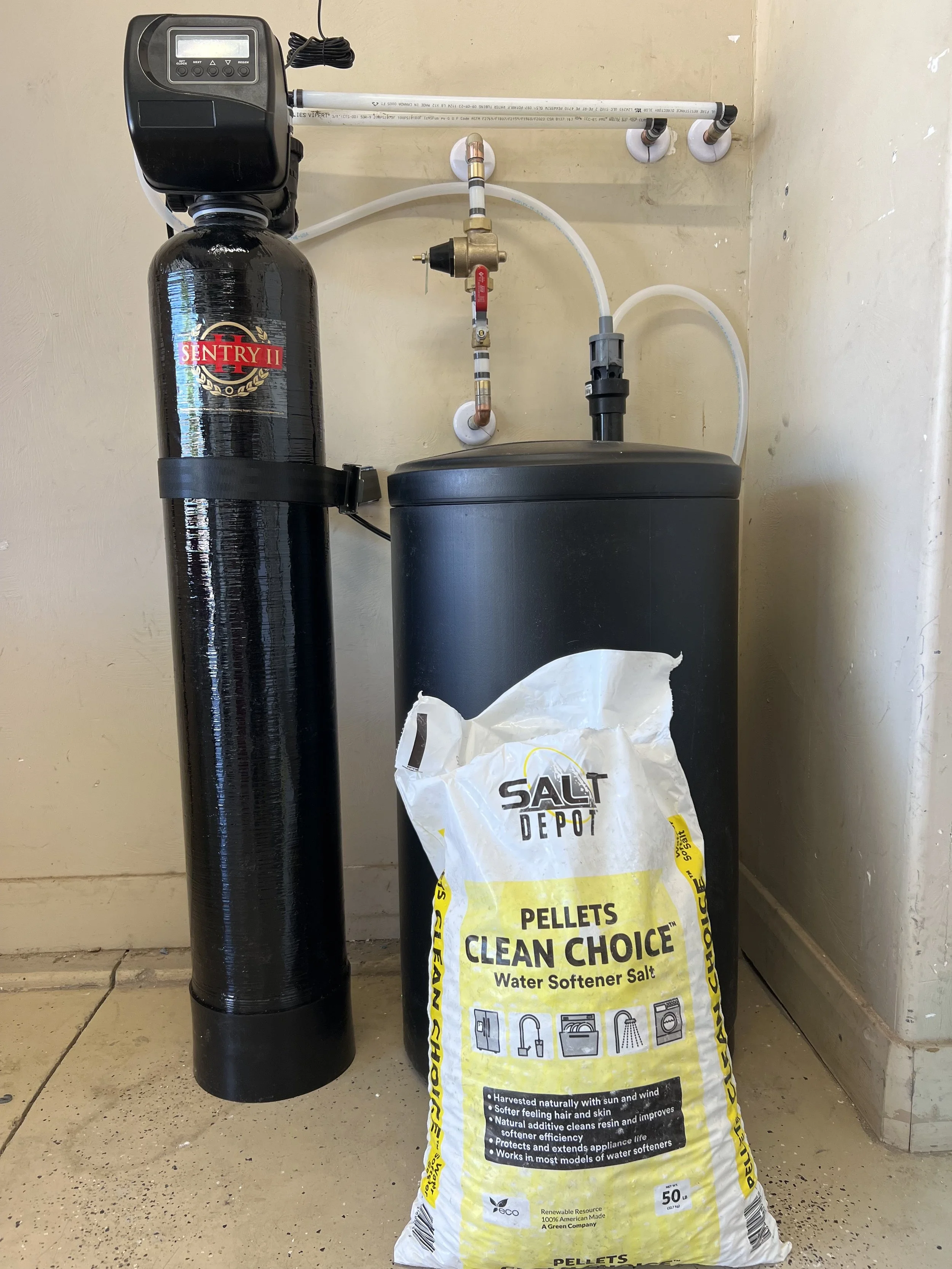
How to Choose the Right Water Softener for Your Home
Choosing a water softener takes more than matching your home's bathroom count to a grain rating. Understand how hardness, flow, household demand and property use influence the right system, from family homes to vacation rentals.
Choosing a water softener is often reduced to household size and a grain capacity printed on the equipment. Those numbers matter, but they do not tell the whole story.
A properly sized water softener has to do two different things well. It needs enough capacity to remove the hardness your household uses between regeneration cycles, and it needs enough service flow to keep up when several fixtures are running at the same time. The plumbing layout, water pressure, outdoor water use, regeneration settings and installation itself also affect how the system performs.
For homeowners in Southern Utah, where hard water is common and household water use can vary considerably, sizing should begin with the water and the home rather than a standard package.
What Actually Determines Water Softener Size?
Several factors determine the appropriate water softener for a home:
Water Hardness: The concentration of dissolved calcium and magnesium determines how much hardness the system must remove from each gallon of water.
Household Water Use: The amount of water passing through the softener determines how quickly its available treatment capacity is used.
Peak Flow Rate: The system must accommodate periods of simultaneous water use, such as multiple showers, appliances or fixtures operating at once, without excessive pressure loss or reduced softening performance.
Resin Volume and Regeneration Settings: The amount of softening resin and the programmed salt dosage determine the system's usable capacity, regeneration frequency and operating efficiency.
Plumbing Configuration: Pipe sizing, available pressure, installation location, irrigation connections and the fixtures receiving softened water all influence equipment selection.
Bathroom count and household size provide useful starting points, but neither is sufficient to determine the correct system on its own.
Start With the Hardness of the Water
Water softener sizing begins with hardness, usually measured in grains per gallon, or GPG. One grain per gallon is approximately 17.1 milligrams per liter of hardness expressed as calcium carbonate. [1]
The harder the incoming water, the more capacity the softener uses for every gallon it treats.
This is particularly relevant in St. George. In its 2024 drinking water report, the City of St. George advised customers using water softeners that settings between 13 and 24 grains per gallon may provide effective treatment. The city's Water Services guidance also recommends approximately 18 grains per gallon as a starting setting, with adjustments up to 22 grains when necessary. [2]
These are general equipment-setting recommendations rather than a measured hardness reading for every property.
Water sources and blending can change, and hardness at the property is more useful for equipment setup than a broad regional assumption. When the recommendation depends on an exact hardness value, testing the water at the home provides better information than selecting a setting simply because it is common in the neighborhood.
For more context on local water sources and reported water quality, see What's in Southern Utah's Drinking Water? Local Test Results Explained.
Capacity Starts With Hardness × Water Use
Once hardness is known, the basic capacity calculation is straightforward:
Hardness in grains per gallon × gallons of water treated = grains of hardness the softener must remove.
If a home uses 250 gallons of softened water per day and the incoming water measures 18 grains per gallon, the softener is being asked to remove approximately 4,500 grains of hardness each day.
Over seven days, that household would place approximately 31,500 grains of demand on the system.
That does not automatically mean a softener advertised as a 32,000-grain system is the correct choice. The equipment's actual usable capacity at its programmed salt dosage, regeneration reserve and flow capability must also be considered.
This is where online sizing calculators can be useful, but they can also create false precision. Many assume a fixed number of gallons per person per day. Actual household use varies, and the gallons that matter are the gallons that will actually pass through the softener.
In Southern Utah, total water use can be misleading
EPA data shows that outdoor water use represents a significant portion of residential consumption nationally and can be considerably higher in the arid West. [3]
That matters when sizing a softener.
Manufacturer installation guidance generally recommends leaving exterior faucets or irrigation on untreated water when practical. Pentair, for example, recommends bypassing outside faucets where possible rather than using softened water for extended outdoor watering. [4]
If landscape irrigation bypasses the softener, a July water bill may be a poor measure of the softener's actual workload. Using the entire household water bill without separating substantial outdoor use can make the system appear to need more capacity than it does.
A better estimate considers the water the softener will actually treat.
Grain Capacity Is Not the Same as Flow Capacity
This is one of the most important distinctions in water softener sizing.
Grain capacity determines how much hardness a softener can remove before regeneration.
Flow capacity determines how much water can move through the softener at one time while it continues to perform properly and without creating excessive pressure loss.
A system can have adequate grain capacity for a household and still be a poor fit if its service flow rate is too low.
Pentair's Fleck installer guidance specifically directs softener sizing around peak flow rather than nominal or average flow. The manufacturer warns that insufficient resin volume at peak demand can allow hardness leakage through the system. [5]
NSF/ANSI 44, the primary certification standard for residential cation exchange water softeners, also evaluates pressure drop and softening capacity separately. [6]
For a homeowner, this means the busiest few minutes of the day can matter as much as total daily consumption.
A home with several showers, a large soaking tub, multiple shower heads, laundry equipment, dishwashers or other simultaneous demands may need greater service flow than another household using the same number of gallons over the course of a day.
This is also why bathroom count is an imperfect sizing tool. It helps estimate potential demand, but the actual fixtures and the way the household uses them tell us more.
The Advertised Grain Number Does Not Tell You Everything
A common softener might be described as a 32,000, 48,000 or 64,000 grain system. Those numbers are useful for comparing general capacity, but they should not be treated as a complete operating specification.
The usable capacity of an ion exchange softener depends on the amount of resin in the system, the characteristics of that resin and the amount of regenerant used during regeneration.
Pentair's Fleck technical documentation makes this distinction explicitly: resin exchange capacity and the capacity of the complete unit are not the same thing, and increasing salt dosage can increase the capacity restored during regeneration. [5]
That creates an important efficiency tradeoff.
A softener does not necessarily need to be programmed to extract the maximum possible grain capacity from the resin every cycle. Using more salt can restore more capacity, but the additional capacity may come at a lower efficiency per pound of salt.
This is why the label on the tank is only the beginning of the sizing conversation.
A useful recommendation should be able to explain both the equipment capacity and how the system will actually be programmed to operate.
Regeneration Is Part of the Design
Ion exchange resin eventually reaches the point where it needs to be regenerated. During regeneration, the system uses a concentrated sodium chloride or potassium chloride solution to restore the resin's ability to exchange hardness ions.
How often this happens depends on incoming hardness, water consumption, available capacity and the control strategy.
Many modern residential softeners use metered or demand initiated regeneration. Rather than regenerating solely because a particular number of days has passed, the control tracks treated water use and initiates regeneration when the programmed capacity is approaching exhaustion.
This is useful in households where water use changes. Guests, travel, seasonal occupancy and changing family routines can all alter consumption.
An undersized system may reach capacity too frequently. An unnecessarily large system may add equipment cost without improving the actual quality of the softened water. Proper sizing is intended to provide enough reserve and reasonable regeneration intervals without treating equipment size as a substitute for good programming.
We will cover regeneration, salt use and routine ownership in greater detail in Living With a Water Softener: Regeneration, Salt and Maintenance.
Large Homes May Need a Different Configuration, Not Just a Larger Tank
Increasing tank size is not the only way to address high demand.
Some large residential systems use two softening tanks so that one can remain in service while the other regenerates. Pentair's residential Fleck 9100 twin tank system, for example, is designed to regenerate one tank while maintaining continuous soft water service through the other. [7]
That type of configuration can be useful where continuous treatment or unusually high demand makes a conventional single tank system less practical.
It is not necessary for every large home. The point is that system design should follow the usage pattern rather than automatically moving to the largest grain number available.
Installation Can Change How Much Water the Softener Has to Treat
Where the softener is connected determines which fixtures receive softened water.
A typical installation places the softener on the home's incoming water supply before the water heater, while leaving irrigation and certain exterior faucets on untreated water where the plumbing allows it. [4]
That accomplishes two things. It provides softened water to the portions of the home where hardness is most relevant, while avoiding unnecessary treatment of large volumes of landscape water.
The exact layout should still be property specific. Existing plumbing may already separate indoor and outdoor water, while other homes may require modifications to do so.
Some homeowners may also make different choices for particular cold water fixtures depending on drinking water preferences and whether the home has a separate reverse osmosis or drinking water filtration system.
The treatment design should account for those decisions before the equipment is sized.
A Good Installation Includes Serviceability
The softener itself is only part of the installation.
A properly planned system needs an appropriate bypass so the equipment can be isolated for service without unnecessarily shutting off water to the entire home. Manufacturer guidance from both Pentair and GE calls for a bypass arrangement as part of a residential softener installation. [4][8]
The regeneration discharge also needs an appropriate drain connection and backflow protection according to the equipment requirements and applicable plumbing code. The system needs adequate pressure, suitable electrical access when the control requires power, room for the brine tank and enough physical clearance for future service.
Placement matters as well. Equipment installed outdoors or in exposed areas must remain within the manufacturer's environmental limitations and be protected from conditions that can damage tanks, controls or plumbing components. [4]
These details are easy to overlook when comparing equipment online, but they have a significant effect on how practical the system is to own and maintain.
Consider the Water Heater at the Same Time
A water softener is installed upstream of the water heater for a reason. Hardness minerals become particularly relevant when water is heated because scale can accumulate on heating surfaces and inside water heating equipment.
When a homeowner is replacing a tank or tankless water heater and considering water treatment at the same time, there is value in evaluating the systems together.
That does not mean a particular softener should be selected solely because of the water heater. It means the water heater is part of the demand, plumbing layout and long term water quality discussion.
See our Water Heater & Tankless Water Heater services, and our upcoming resource Water Treatment and Water Heaters: Why They Should Be Planned Together for a deeper look at that relationship.
What About Salt, Potassium and Salt Free Systems?
The regenerant and treatment method are separate decisions from basic sizing.
Most conventional ion exchange systems are regenerated with sodium chloride, while many are also compatible with potassium chloride when appropriately configured. Salt free conditioners operate differently and generally do not remove hardness through ion exchange.
Those differences affect maintenance, operating cost and the characteristics of the finished water, but they should not be confused with whether the equipment has enough capacity and flow for the home.
For those decisions, see:
Salt vs. Potassium Chloride in a Water Softener
Salt Free Water Conditioner vs. Traditional Water Softener
If you are still deciding whether softening is the right treatment method at all, start with Water Softener vs. Whole Home Filtration vs. Reverse Osmosis.
Questions Worth Asking Before Choosing a Water Softener
A homeowner does not need to perform every sizing calculation personally, but the recommendation should make sense when it is explained.
Before selecting a system, you should be able to answer:
What is the hardness of the water being used for sizing? A tested number is more useful than a broad assumption.
How much water is the softener expected to treat? Outdoor irrigation and bypassed fixtures should not automatically be included.
Can the system support the home's peak flow? Grain capacity alone does not answer this question.
What is the system's working capacity at the programmed salt setting? The advertised grain rating may not be the same as the capacity used between normal regenerations.
How is regeneration controlled? The settings should reflect hardness, available capacity and household use.
How will the equipment be integrated into the plumbing? Bypass arrangement, drain, power, outdoor water and future service access should be considered before installation.
Those questions reveal considerably more about a proposed system than the tank size alone.
How Artisan Plumbing Sizes a Water Softener
At Artisan Plumbing, water softener selection begins with the conditions the equipment will actually operate under.
We look at the hardness being treated, household water demand, likely peak flow, existing pipe size and pressure, outdoor water connections, water heating equipment, available installation space and the requirements for drainage and service access. From there, we can determine the appropriate equipment capacity, flow capability and installation configuration.
That process is intentionally different from choosing a standard package based on the number of bedrooms or bathrooms.
Our goal is to install a system that performs correctly when the home is busy, regenerates appropriately for the household's actual use and remains practical to service over the long term.
For homeowners considering a new installation or replacing an existing system, learn more about Artisan Plumbing's water softener and whole home water treatment services in St. George and throughout Washington County.
For homeowners exploring more than hardness treatment, our Drinking Water Filtration & Reverse Osmosis page and Southern Utah Water Quality resource provide additional information on drinking water treatment and local water conditions.
Sources
[1] Pentair. Understanding Water Hardness Levels & Effects. Pentair defines one grain per gallon as approximately 17.1 ppm and provides standard hardness classifications.
[2] City of St. George. 2024 Drinking Water Quality Report and Water Services — Collection and Distribution. The city's annual report describes Southern Utah's hard water and gives a general softener-setting range of 13 to 24 grains per gallon. Its Water Services guidance recommends beginning around 18 grains and adjusting as needed up to 22.
[3] U.S. Environmental Protection Agency, WaterSense. Statistics and Facts. EPA reports that outdoor use represents a significant share of household consumption and can be substantially higher in the arid West.
[4] Pentair. Whole House Water Softening System Installation and Operation Manual. Installation guidance addresses outside faucet bypass, placement ahead of the water heater, drain requirements and system location.
[5] Pentair Fleck. Installer Manual, Fleck 9100 SXT. Sizing guidance identifies hardness, peak and nominal flow, service velocity and salt dosage as sizing parameters and distinguishes resin exchange capacity from total unit capacity.
[6] NSF. NSF/ANSI 44 Technical Requirements. The residential cation exchange softener standard evaluates hardness reduction, pressure drop, softening capacity, rinse performance, brine-system accuracy and related performance requirements.
[7] Pentair. Fleck 9100 Control Valve. Twin tank residential configuration designed for continuous soft water service during regeneration.
[8] GE Appliances. Water Softener Bypass Options and Water Softener Installation Location. Manufacturer guidance addresses bypass systems, outside water lines, placement, drainage and service access.
Tank vs. Tankless Water Heaters in Southern Utah: Which Is Right for Your Home?
Tank or tankless? The right choice depends on more than bathroom count. Learn how flow rate, temperature rise, water pressure, recirculation, plumbing layout, hard water, and long term ownership all affect water heater selection in Southern Utah.
For many Southern Utah homeowners planning to stay in their home long term, a properly sized tankless water heater is the stronger choice. Tankless systems can provide continuous hot water within their rated capacity, take up significantly less space, reduce standby energy loss and generally have a longer expected service life than traditional storage tanks. A conventional tank can still be the right choice when the goal is a straightforward replacement and the existing system already meets the household’s needs. [1][2]
The important part is properly sized.
Choosing a water heater should involve more than counting bathrooms or replacing a 50 gallon tank with another 50 gallon tank. Flow rate, temperature rise, water pressure, pipe sizing, recirculation, gas or electrical capacity, water quality and the way the home was originally plumbed can all change the answer.
That is especially important in Southern Utah, where hard water and large homes with long plumbing runs are common considerations.
Tank vs. Tankless at a Glance
Conventional TankTanklessHot water supplyLimited to stored volume and recoveryContinuous within the unit’s rated capacitySpaceRequires floor space for the tankCompact and typically wall mountedExpected lifespanCommonly about 8 to 12 yearsCommonly 15 to 20 years or more with proper maintenanceStandby heat lossYesMinimal because water is heated on demandRecirculationCompatibleAdvanced recirculation options availableHigh demand homesDepends on tank size and recoveryDepends on simultaneous flow and temperature riseHard water concernsSediment and tank corrosionScale inside the heat exchangerBest fitSimple replacement and predictable demandLong term ownership, continuous hot water, space savings and system upgrades
Expected life varies with equipment, installation, water chemistry, use and maintenance. Rheem currently describes traditional tank life as approximately 8 to 12 years and tankless life as approximately 15 to 20 years or more with proper care. [2] Rheem
Why Bathroom Count Is Not Enough
One of the most common ways tankless water heaters are marketed is by bathroom count.
A chart might suggest one size for a two bathroom house and another for a four bathroom house. That is useful as a rough starting point, but it is not how we want to make the final decision.
A four bathroom home occupied by two people may have relatively low simultaneous demand. A two bathroom home with a large primary shower, rain head, handheld shower, body sprays and a high flow tub filler can require considerably more hot water at one time.
The more useful question is:
How much hot water could this house realistically use at the same time?
EPA WaterSense showerheads are limited to 2.0 gallons per minute. Two showers operating simultaneously can therefore represent roughly 4 GPM before adding a kitchen faucet, another bathroom fixture or other hot water demand. Multiple showering devices can increase the total further. [3] EPA
That simultaneous demand matters much more than the number of bathroom doors in the house.
Tankless Sizing Is About Flow Rate and Temperature Rise
Gallons per minute are only half of tankless sizing.
The other half is temperature rise, or how much the incoming water must be heated before it reaches the desired outlet temperature.
If water enters the heater at 60°F and the system is set to provide 120°F water, the heater needs to produce a 60°F temperature rise.
The greater that temperature rise, the less water a given tankless unit can heat at one time.
Navien’s NPE 240A2 illustrates this clearly. Navien rates the unit at 11.2 GPM with a 35°F temperature rise, 7.1 GPM with a 55°F rise and 6.0 GPM with a 65°F rise. [4] It is the same water heater in every example. Navien
That is why the largest GPM number on a product page should never be treated as the amount of hot water a home will receive under every condition.
Actual tankless capacity depends on both demand and required temperature rise.
Water Pressure and Pipe Size Still Matter
A tankless water heater heats water. It does not create water pressure or correct restrictions elsewhere in the plumbing system.
If the house has undersized piping, a restrictive pressure regulator, filtration equipment, a water softener issue or another source of pressure loss, changing the water heater will not make those restrictions disappear.
There is also an important difference between static pressure and dynamic pressure.
Static pressure is what a gauge reads when the plumbing system is not flowing. Dynamic pressure is what the system can maintain while fixtures are actually running.
For a home with multiple bathrooms or high flow fixtures, what happens when several fixtures operate at once is far more useful than a single pressure reading with everything turned off.
The hot water distribution piping matters for the same reason. Pipe diameter, length and layout affect how much water can move through the system and how quickly hot water reaches distant fixtures.
Tankless Does Not Automatically Mean Instant Hot Water
This distinction is important.
Tankless means on demand heating. It does not necessarily mean instant delivery.
If the water heater is in the garage and the primary bathroom is on the opposite side of the house, the water sitting inside that hot water line has to leave before newly heated water arrives.
Installing a tankless heater does not eliminate the physical volume of water inside the piping.
This is where recirculation becomes important.
How Recirculation Changes the System
A dedicated hot water recirculation line returns water from the distribution system back toward the heater, reducing the amount of cooled water that has to be discharged before hot water reaches the fixture.
Some Southern Utah homes already have a dedicated return line. Others were not plumbed with one.
Those homes should not automatically be treated the same way.
For whole home gas tankless installations, Artisan Plumbing primarily installs Navien, and recirculation is one reason. Navien’s NPE A2 ComfortFlow system incorporates a small internal buffer tank, recirculation pump and controls into the tankless unit. Navien states that the system is designed to reduce the cold water sandwich effect and reduce hot water delivery time. [5] Navien
Recirculation still needs to be configured correctly.
Running an external pump continuously is not necessarily better. Navien’s own warranty distinguishes between controlled and uncontrolled recirculation. For qualifying residential NPE A2 installations, its published heat exchanger warranty is 15 years under standard or controlled recirculation versus 5 years under uncontrolled recirculation. [6] Navien
That is a good example of why the water heater and the plumbing around it need to be considered as one system.
Can Tankless Be Paired With a Storage Tank?
Yes.
The choice is not always limited to either a traditional storage water heater or one standalone tankless unit.
Tankless equipment can also be incorporated into a system with supplemental hot water storage.
This can be useful in more demanding applications where the plumbing design benefits from having stored hot water available while tankless equipment provides heating and recovery. The exact configuration depends on the home and its demand.
This is not an improvised concept. Navien publishes specific piping diagrams for NPE tankless systems used with one or more storage tanks. [7] Navien
For most homes, this level of design is unnecessary. But it is important because it demonstrates why large or unusual homes should not be reduced to a simple online sizing chart.
Sometimes the best answer is a water heating system, not a single appliance.
Southern Utah Hard Water Matters
Water quality needs to be part of any serious water heater discussion in Washington County.
Washington City’s drinking water information describes Southern Utah water sources as ranging from hard, at 7 to 10 grains per gallon, to very hard, above 10 grains per gallon. The hardness comes primarily from naturally occurring calcium and magnesium. [8] Digital Library of Utah
Water conditions can also vary by location and water source. The Washington County Water Conservancy District reports that more than 80 percent of the drinking water it delivers comes from surface water, with the remainder coming from groundwater. Municipalities may also blend district water with additional sources. [9] WCWCD
That means we do not assume every house in St. George, Washington or elsewhere in the county has identical water chemistry.
Hard water and tank water heaters
Minerals can accumulate as sediment in the bottom of a storage tank.
The steel tank itself is also protected by an anode rod. Bradford White describes the anode as a sacrificial component that gives up its electrons to help protect the carbon steel tank, with water chemistry affecting how quickly that anode is consumed. [10] Bradford White For The Pro®
Eventually, a conventional storage tank remains a vessel that can corrode and leak.
Hard water and tankless water heaters
Tankless removes the large storage vessel, but it does not eliminate mineral maintenance.
Scale can form inside the heat exchanger and reduce heat transfer and performance.
That is why water treatment and appropriate maintenance matter in Southern Utah regardless of which system is selected.
Tankless should not be sold as maintenance free. Its advantage is a different system design with a longer expected service horizon when it is installed and maintained properly.
Why We Generally Favor Gas Tankless for Long Term Ownership
For many homeowners who expect to remain in their home for years, gas tankless has several meaningful advantages.
It eliminates the large storage tank, takes up very little floor space, provides continuous hot water within its rated capacity and avoids the standby losses associated with keeping a tank full of water hot throughout the day.
DOE reports that on demand water heaters can be 24 to 34 percent more energy efficient than conventional storage water heaters in households using 41 gallons or less of hot water per day. For households using around 86 gallons per day, DOE estimates an 8 to 14 percent advantage. [1] The Department of Energy's Energy.gov
Current ENERGY STAR requirements for certified gas tankless water heaters require a UEF of at least 0.95. [11] Navien’s NPE 240A2, for example, is rated at 0.95 UEF and uses condensing technology with dual stainless steel heat exchangers. ENERGY STAR
Tankless also has a longer expected useful life. ENERGY STAR currently cites a life expectancy of about 20 years for gas tankless water heaters, while manufacturer guidance commonly places traditional tanks around 8 to 12 years. [2][12] ENERGY STAR
Those advantages are why we see tankless as the stronger long term direction for many gas equipped Southern Utah homes.
When a Traditional Tank Still Makes Sense
A conventional tank is not automatically the wrong choice.
If a homeowner wants a straightforward replacement, the current tank system works well for the household, hot water demand is predictable and there is little reason to redesign the surrounding plumbing, another tank may be completely appropriate.
Ownership horizon matters too.
Someone planning to remain in a home for fifteen years may place significant value on the longer expected life, space savings and additional capabilities of a tankless system.
Someone expecting to move relatively soon may reasonably prioritize a simpler replacement.
For conventional tank installations, Artisan Plumbing uses Rheem or Bradford White, with the specific equipment selected according to the fuel type, available space, capacity and conditions of the home.
We do not believe one storage tank is the correct answer for every house.
What About Electric Tankless?
For electric tankless applications, Artisan Plumbing primarily installs Rheem.
Electric tankless has some of the same advantages as gas tankless. It is compact, heats water on demand and eliminates the traditional storage tank.
The major consideration is electrical capacity.
Heating several gallons of water per minute instantaneously with electricity can require a substantial electrical load. As one example, Rheem lists a 208 volt configuration of its 36 kW RETEX 36 at 127 amps with four recommended 40 amp breakers. [13] Rheem
That does not make electric tankless impractical. It simply means the electrical service, panel capacity and desired hot water demand need to be evaluated before selecting equipment.
Gas tankless and electric tankless solve the same basic problem in very different ways.
What Artisan Looks at Before Recommending Tank or Tankless
For a Southern Utah home, we want to understand the whole system, including the number of occupants, realistic simultaneous fixture use, shower and tub flow rates, required temperature rise, dynamic water pressure, pipe sizes, plumbing layout, water heater location, existing recirculation, gas or electrical capacity and water quality.
We also want to know what the homeowner is trying to accomplish.
Running out of hot water is one problem. Waiting too long for hot water at a distant bathroom is another. Poor water pressure is another. Hard water scale is another.
Changing the water heater can solve some of those problems, but it cannot automatically solve all of them.
That distinction is what allows the equipment to be selected around the home rather than expecting the home to work around the equipment.
Tank or Tankless: The Bottom Line
For many gas equipped homes in St. George and throughout Southern Utah, particularly when the homeowner plans to stay long term, we believe a properly designed tankless system is the stronger long term choice.
For whole home gas tankless installations, Artisan Plumbing primarily installs Navien. For electric tankless applications, we primarily use Rheem. When a traditional storage water heater makes more sense, we install Rheem or Bradford White based on the needs of the home.
But the brand and model come after the plumbing is evaluated.
Bathroom count alone is not enough.
A good water heater decision accounts for how much hot water the house actually uses, how quickly that water needs to be heated, how it moves through the plumbing, what happens to pressure under demand, whether recirculation is present and how Southern Utah water will affect the equipment over time.
The best water heater is the one designed to work with the house around it.
Frequently Asked Questions
Is a tankless water heater worth it in St. George, Utah?
For many homeowners who plan to stay in their home long term, yes. Tankless can provide continuous hot water within its rated capacity, save space, reduce standby energy loss and offer a longer expected service life. The home’s plumbing, gas or electrical capacity, recirculation and water quality should still be evaluated before converting.
How many bathrooms can one tankless water heater handle?
There is no reliable answer based on bathroom count alone. A tankless heater should be sized according to simultaneous flow demand and temperature rise. A two bathroom home with several high flow shower fixtures can require more capacity than a four bathroom home with modest simultaneous use.
Does tankless give you instant hot water?
Not automatically. Tankless heats water on demand, but hot water still has to travel through the piping between the heater and the fixture. Plumbing layout and recirculation determine how quickly hot water arrives.
Does Southern Utah hard water affect tankless water heaters?
Yes. Mineral scale can accumulate inside a tankless heat exchanger. Traditional tanks are also affected by hard water through sediment accumulation and the interaction between water chemistry, the tank and its sacrificial anode. Proper maintenance and water treatment should be considered with either system.
Can a tankless water heater be used with a storage tank?
Yes. Manufacturers publish system designs that combine tankless heating with supplemental storage for certain applications. This can be useful in homes with unusual demand or more complex water heating requirements. The configuration should be designed specifically for the application. Navien
Sources
1. U.S. Department of Energy, Energy Saver: Tips on Saving Money and Energy in Your Home. DOE reports the efficiency ranges for on demand water heaters compared with conventional storage water heaters. The Department of Energy's Energy.gov
2. Rheem Manufacturing Company, Water Heater Lifespan: When to Repair vs. Replace and Tank vs. Tankless Water Heater Lifespan Comparison. Current manufacturer guidance places traditional tanks around 8 to 12 years and tankless equipment around 15 to 20 years or more with proper care. Rheem
3. U.S. Environmental Protection Agency, WaterSense Showerhead Specification and Technical Guidance. WaterSense labeled showerheads are limited to 2.0 GPM and EPA guidance addresses multiple showering devices. EPA
4. Navien, NPE 240A2 Technical Specifications. Manufacturer flow ratings illustrate the relationship between temperature rise and available GPM. Navien
5. Navien, NPE A2 ComfortFlow System. Navien documents the integrated buffer tank, recirculation pump and controls used in applicable NPE A2 models. Navien
6. Navien, NPE A2 Residential Warranty. Manufacturer warranty terms distinguish controlled recirculation from uncontrolled recirculation. Navien
7. Navien, NPE 2 Piping Applications. Navien publishes application drawings for tankless systems used with one or more storage tanks. Navien
8. Washington City, Utah, Annual Drinking Water Quality Report. The city describes Southern Utah water sources as ranging from hard to very hard because of naturally occurring calcium and magnesium. Digital Library of Utah
9. Washington County Water Conservancy District, Water Quality. WCWCD describes the region’s surface and groundwater sources and notes that retail providers may blend district water with other sources. WCWCD
10. Bradford White, Water Heater Anode Rods. Bradford White explains the sacrificial anode process and the role water chemistry plays in tank protection. Bradford White For The Pro®
11. ENERGY STAR, Residential Water Heater Key Product Criteria. Current criteria require qualifying gas fired instantaneous water heaters to achieve at least 0.95 UEF. ENERGY STAR
12. ENERGY STAR, Save More with ENERGY STAR Gas Tankless Water Heaters. ENERGY STAR cites approximately 20 years of life expectancy for gas tankless equipment. ENERGY STAR
13. Rheem, RETEX 36 Electric Tankless Water Heater Specifications. Manufacturer electrical specifications demonstrate the electrical demand associated with larger whole home electric tankless systems.
Fall Plumbing Maintenance in Southern Utah: What Homeowners Actually Need to Do
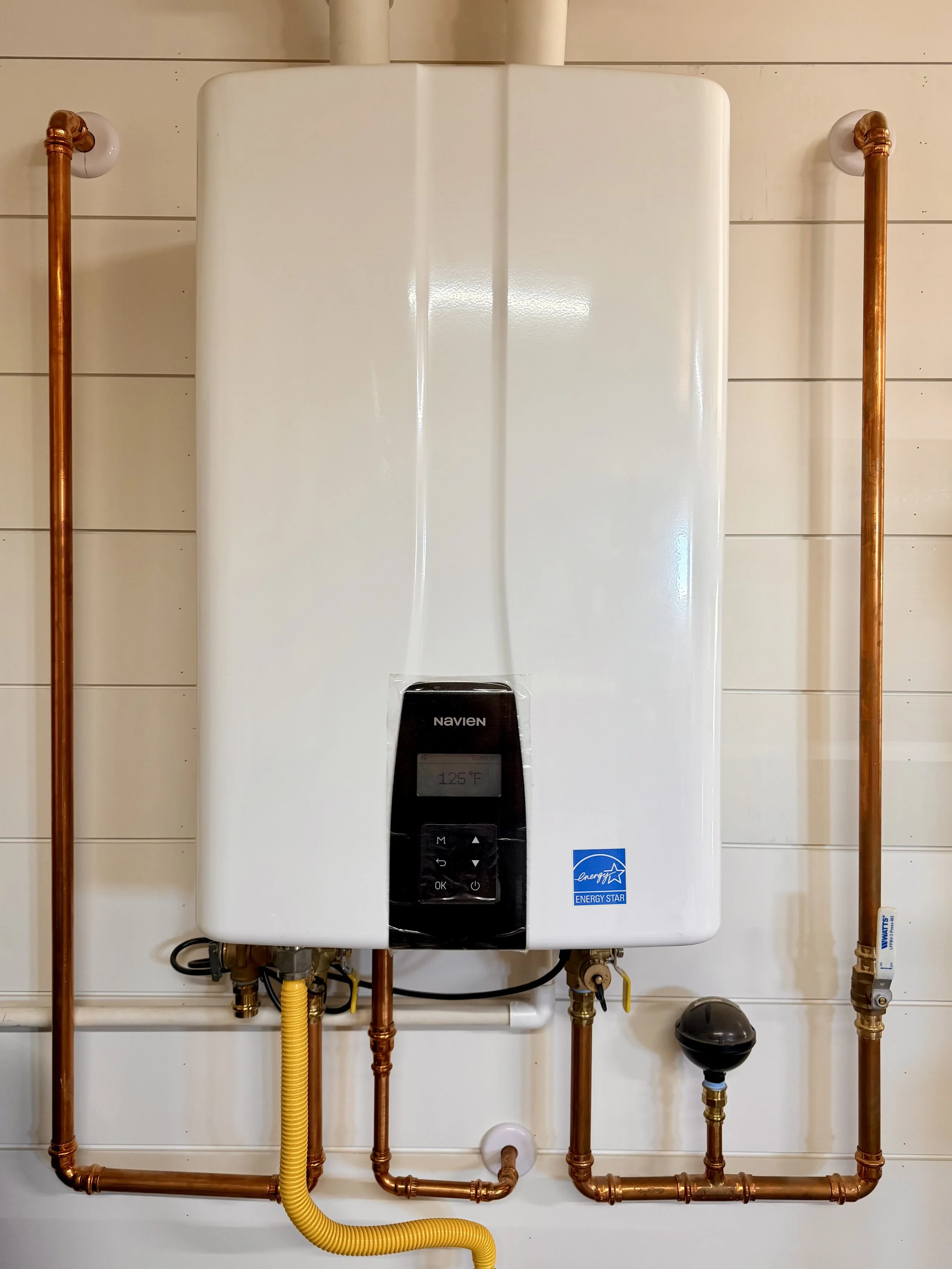
A practical fall plumbing guide for Southern Utah homeowners covering the maintenance that actually matters before winter, from water shutoffs and exposed plumbing to annual water heater service and water pressure.
Fall plumbing maintenance in Southern Utah is relatively simple, but a few items deserve attention before freezing temperatures arrive. Homeowners should know where their main water shutoff is, disconnect hoses, protect exposed plumbing and irrigation components, keep annual water heater maintenance current, and make sure household water pressure is within a safe range.
St. George winters are mild compared with northern Utah, but freezing temperatures are still part of our climate. Historical Utah Climate Center data for St. George puts the average first fall freeze around October 29, with a median date of November 1.[1]
Southern Utah also has another plumbing concern that does not disappear with the seasons: hard water. That makes fall a useful time to address both cold weather preparation and routine maintenance before winter.
Know Where Your Main Water Shutoff Is
Every homeowner should know where the main water shutoff is before there is an emergency.
If a supply line fails, a pipe breaks, or a water heater begins leaking, shutting off the water quickly can greatly reduce property damage. Utah State University Extension specifically recommends that adults and older children know where the main shutoff is and how to use it.[2]
Locate the valve and make sure it is accessible rather than buried behind storage or landscaping.
There is one important caveat. If an older shutoff valve is badly corroded, leaking, difficult to operate, or has not been moved in years, do not force it simply for the sake of testing it. A questionable valve is better evaluated and repaired before an emergency than discovered during one.
Disconnect Garden Hoses Before Freezing Weather
Even a frost proof hose bib can be damaged if a hose or other attachment prevents it from draining correctly.
A standard frost proof faucet is designed so that the actual shutoff point sits farther inside the structure. When the faucet is turned off and the hose is removed, the remaining water can drain from the exposed portion of the faucet.
If a hose, splitter, timer, or other restriction remains attached, water can stay trapped inside. When that water freezes and expands, the faucet tube can split.[3]
Before freezing temperatures arrive:
• Disconnect garden hoses
• Remove splitters, timers, and other attachments that prevent drainage
• Check hose bibs for dripping or looseness
• Look for damaged insulation or exposed piping nearby
A leaking hose bib should be repaired rather than simply covered for winter.
Check Plumbing in Garages and Other Vulnerable Areas
The plumbing most vulnerable to a Southern Utah freeze is often outside the conditioned living area of the home.
Pay particular attention to:
• Garages
• Workshops
• Casitas
• Outdoor kitchens
• RV hookups
• Utility areas
• Pool equipment areas
• Exterior water lines
• Plumbing near exterior doors or openings
Look for exposed water lines, missing or deteriorated insulation, leaking fittings, and areas where cold air can reach plumbing.
The goal is not to insulate every pipe in the house. It is to identify the portions of the plumbing system that are genuinely exposed to colder conditions.
Prepare Irrigation and Backflow Equipment for Winter
Southern Utah irrigation should be adjusted for our actual climate rather than following a winterization schedule written for much colder regions.
The Washington County Water Conservancy District recommends reducing irrigation to no more than once per week from November through February and notes that irrigation is typically unnecessary in December and January.[4]
When irrigation use winds down, homeowners should know where the irrigation shutoff is located and make sure exposed components are protected from freezing.
Utah State University recommends shutting off the irrigation water supply, releasing pressure from the system, opening drain valves where applicable, and draining water from components that can freeze.[5]
Pay particular attention to exposed backflow assemblies, valves, and above ground piping. A short period of freezing weather can damage these components even when underground irrigation piping is adequately protected.
The exact winterization process depends on how the system was designed. Some systems drain easily. Others require additional steps.
Make Annual Water Heater Maintenance Part of Your Routine
Water heater maintenance is particularly important in Washington County because of our hard water.
The City of St. George currently advises residents using water softeners to generally start around an 18 grain setting and adjust higher if needed, up to 22 grains.[6] That is a useful indication of the mineral load local plumbing and water heating equipment routinely encounter.
Heating hard water encourages mineral scale and sediment to accumulate inside water heating equipment.
How Often Should a Tank Water Heater Be Flushed in Southern Utah?
For Southern Utah homes, annual maintenance is a practical minimum.
Inside a traditional tank water heater, mineral sediment settles at the bottom of the tank. Over time, that buildup can interfere with heat transfer, contribute to noise, and affect water heater performance.
Bradford White identifies sediment as a significant concern, particularly in hard water areas, and includes tank draining and flushing as part of regular water heater maintenance.[7] Rheem also recommends routine flushing and notes that hard water can require more frequent service.[8]
In especially hard water conditions, annual service may not always be enough. The appropriate interval can depend on the home's water treatment, water usage, equipment, and the amount of sediment present.
How Often Should a Tankless Water Heater Be Descaled in Southern Utah?
Tankless water heaters should also receive at least annual maintenance in our area.
Tankless does not mean scale free. Instead of settling at the bottom of a storage tank, minerals can accumulate inside the heat exchanger.
Navien recommends descaling at least once per year and specifically notes that higher mineral content, higher water temperatures, and greater hot water use may require more frequent descaling.[9]
A proper tankless maintenance service may also include cleaning filters, inspecting the condensate system on condensing units, checking for leakage or corrosion, and evaluating the overall condition of the installation.
For Washington County homeowners, annual water heater maintenance should be viewed as routine preventive maintenance rather than something to postpone until the unit begins showing symptoms.
If You Have a Tankless Water Heater, Keep Freeze Protection in Mind
Many modern tankless water heaters have built in freeze protection, but it has limitations.
For example, Navien instructs homeowners to keep the unit connected to electricity during freezing conditions because its internal freeze protection requires power. The manufacturer also notes that built in freeze protection does not protect exterior water piping or the condensate drain line on a condensing system.[10]
That makes garage and exterior installations especially important to evaluate before freezing weather.
If a tankless water heater will be shut down at a vacant or seasonal property during winter, proper winterization generally requires more than simply turning the unit off. Follow the manufacturer's procedure for the specific equipment.
Check Your Home's Water Pressure
High water pressure can feel like a benefit at the faucet, but excessive pressure puts unnecessary stress on the plumbing system.
The plumbing code adopted in Utah limits static water pressure to 80 psi. When incoming pressure exceeds that level, an approved pressure reducing valve is required to regulate pressure entering the home's plumbing system.[11]
A pressure reducing valve can wear out over time. When it does, household pressure may gradually increase without producing one obvious failure.
Excessive pressure can place additional stress on:
• Faucet cartridges
• Toilet fill valves
• Appliance supply lines
• Water heater components
• Shutoff valves
• Other fixtures and connections throughout the home
A simple pressure test provides useful information about the condition of the home's water supply system and can identify a failing regulator before it causes other problems.
Look for Small Leaks Before They Become Larger Problems
Fall is also a good opportunity to look at the plumbing you can easily see.
Check under sinks, around toilets, at appliance connections, around the water heater, and anywhere there has been previous plumbing work.
Watch for:
• Moisture
• Water staining
• Mineral deposits
• Corrosion
• Warped cabinetry
• Dampness
• Dripping valves or fittings
Small leaks often leave evidence before they become significant failures.
If You Suspect a Hidden Leak, Check the Water Meter
There is no reason to perform a lengthy water meter test as part of every fall checklist. It becomes useful when there is actually a reason to suspect a hidden leak.
Possible signs include an unexplained increase in the water bill, hearing water when no fixtures are running, unexpected moisture, or water use that does not make sense.
The EPA's WaterSense program recommends reading the water meter, using no water for approximately two hours, and then checking the meter again. If the reading changes while no water was intentionally used, there is likely water moving somewhere in the system.[12]
The meter cannot tell you where the leak is, but it can help confirm that further investigation is warranted.
Possible sources include toilets, irrigation, fixtures, appliance connections, water heaters, or concealed water lines.
What Does Not Need to Become a “Fall Plumbing Task”
Not every plumbing service belongs on a seasonal checklist.
A garbage disposal does not require a fall inspection simply because the weather changed. Neither does a sewer camera inspection, whole home repipe evaluation, or arbitrary inspection of every drain.
Those systems should be evaluated when there are symptoms, known risks, or a legitimate maintenance reason to inspect them.
A useful fall plumbing check should focus on conditions that actually change as Southern Utah moves into winter and preventive maintenance the plumbing system already needs.
Southern Utah Fall Plumbing Checklist
Before colder weather arrives:
• Locate your main water shutoff and make sure it is accessible
• Make sure the adults in the home know how to shut off the water
• Disconnect garden hoses, splitters, and timers
• Check exterior hose bibs for leaks or damage
• Inspect exposed plumbing in garages, casitas, outdoor kitchens, and other vulnerable areas
• Prepare irrigation and exposed backflow equipment for freezing conditions
• Complete annual maintenance on tank and tankless water heaters
• Make sure tankless freeze protection can operate where applicable
• Check household water pressure
• Look for visible signs of leaks
• Use the water meter as a diagnostic tool if a hidden leak is suspected
Some of these tasks are simple for homeowners to handle themselves. Others require equipment, experience, or a closer evaluation of the plumbing system.
Common Fall Plumbing Questions in Southern Utah
Do pipes actually freeze in St. George, Utah?
Yes. Southern Utah has relatively mild winters, but freezing temperatures still occur. Historical St. George climate data places the average first fall freeze around October 29.[1] Plumbing in garages, exterior walls, outdoor kitchens, utility spaces, and other exposed locations can be particularly vulnerable.
Do I need to disconnect a hose from a frost proof faucet?
Yes. Standard frost proof faucets need to drain after they are turned off. A hose or attachment left connected can trap water inside the faucet and allow it to freeze and split.[3]
How often should I flush my water heater in Southern Utah?
Annual maintenance is a practical minimum for both tank and tankless water heaters in Washington County because of our hard water. Depending on the equipment, water treatment, mineral content, and household usage, more frequent service may be appropriate.[7][8][9]
Can a tankless water heater freeze?
Yes. Some tankless units have built in freeze protection, but that protection generally requires electricity and does not necessarily protect connected piping or condensate drains. Manufacturer instructions for the specific unit should always be followed.[10]
What water pressure is too high for a house?
Utah's adopted plumbing code limits static residential water pressure to 80 psi. When supply pressure exceeds that level, a pressure reducing valve is required.[11]
How can I tell if I have a hidden water leak?
If you suspect a leak, turn off all intentional water use and compare your water meter reading over approximately two hours. If the reading changes, water is likely moving somewhere in the system and the source should be investigated.[12]
Fall Plumbing Readiness in Southern Utah
Good fall plumbing maintenance is not about creating a long list of seasonal services homeowners do not need. It is about identifying the few areas where colder weather and Southern Utah's water conditions create legitimate risks.
Artisan Plumbing's Fall Plumbing Readiness Service focuses on those practical items, including water pressure, shutoff valves, vulnerable exterior plumbing, visible leaks, and annual water heater maintenance.
We evaluate what is actually there, explain what we find, and recommend repairs or maintenance where there is a reason to do it.
Artisan Plumbing serves St. George, Washington, Hurricane, Ivins, Santa Clara, and surrounding Washington County communities.
Sources
[1] Utah Climate Center, Utah State University. St. George Freeze Details. Historical St. George freeze data through 2025.
[2] Utah State University Extension. Advice to Prevent Frozen Pipes. Guidance on freeze protection and knowing the location of the home's main water shutoff.
[3] Woodford Manufacturing. How a Standard Frost Proof Faucet Works. Manufacturer guidance on faucet drainage and freeze damage caused by attached hoses or improper drainage.
[4] Washington County Water Conservancy District. Watering Guide. Seasonal irrigation recommendations for Washington County.
[5] Utah State University Extension. Irrigation System Maintenance. Peer reviewed guidance for winterizing residential irrigation systems.
[6] City of St. George Water Services. Water Distribution. Current local guidance for residential water softener settings.
[7] Bradford White. Spring Cleaning for Your Water Heater: A Maintenance Guide. Manufacturer guidance regarding sediment, hard water, and regular tank flushing.
[8] Rheem. How to Keep Your Tank and Tankless Water Heaters Running at Peak Performance and How Often to Flush Your Water Heater. Manufacturer maintenance guidance addressing annual service and hard water conditions.
[9] Navien. How to Descale Your Tankless Water Heater and Tankless Water Heater Maintenance Tips. Manufacturer guidance recommending at least annual descaling and additional maintenance in higher mineral content water.
[10] Navien. Preventing a Frozen Tankless Water Heater. Manufacturer guidance regarding electrical power, internal freeze protection, exterior piping, and condensate drains.
[11] Utah State Construction Code and 2021 International Plumbing Code, Section 604.8. Utah's adopted plumbing code limits static water pressure to 80 psi and requires pressure regulation where incoming pressure exceeds that level.
[12] U.S. Environmental Protection Agency WaterSense. Home Maintenance and Fix a Leak Week. Guidance for using a water meter to help identify suspected household leaks.
What’s in Southern Utah’s Drinking Water? Local Test Results Explained.
What do local drinking water tests reveal? Explore Southern Utah's arsenic, fluoride, chlorine and mineral levels, compared with federal standards and health guidelines.
Southern Utah's drinking water contains more than just minerals. Public testing in Washington County documents arsenic, fluoride, dissolved solids, and substances formed during water treatment.
We compared local water quality reports with EPA standards, national data, and Environmental Working Group (EWG) health guidelines to see what the results actually mean.
KEY TAKEAWAY
Southern Utah's reported water quality varies by source and municipality. Water can meet federal drinking water standards while still containing measurable substances that homeowners may prefer to filter.
St. George's historical arsenic average, for example, was substantially higher than the national utility average, even though the reported average was below the federal limit. [3]
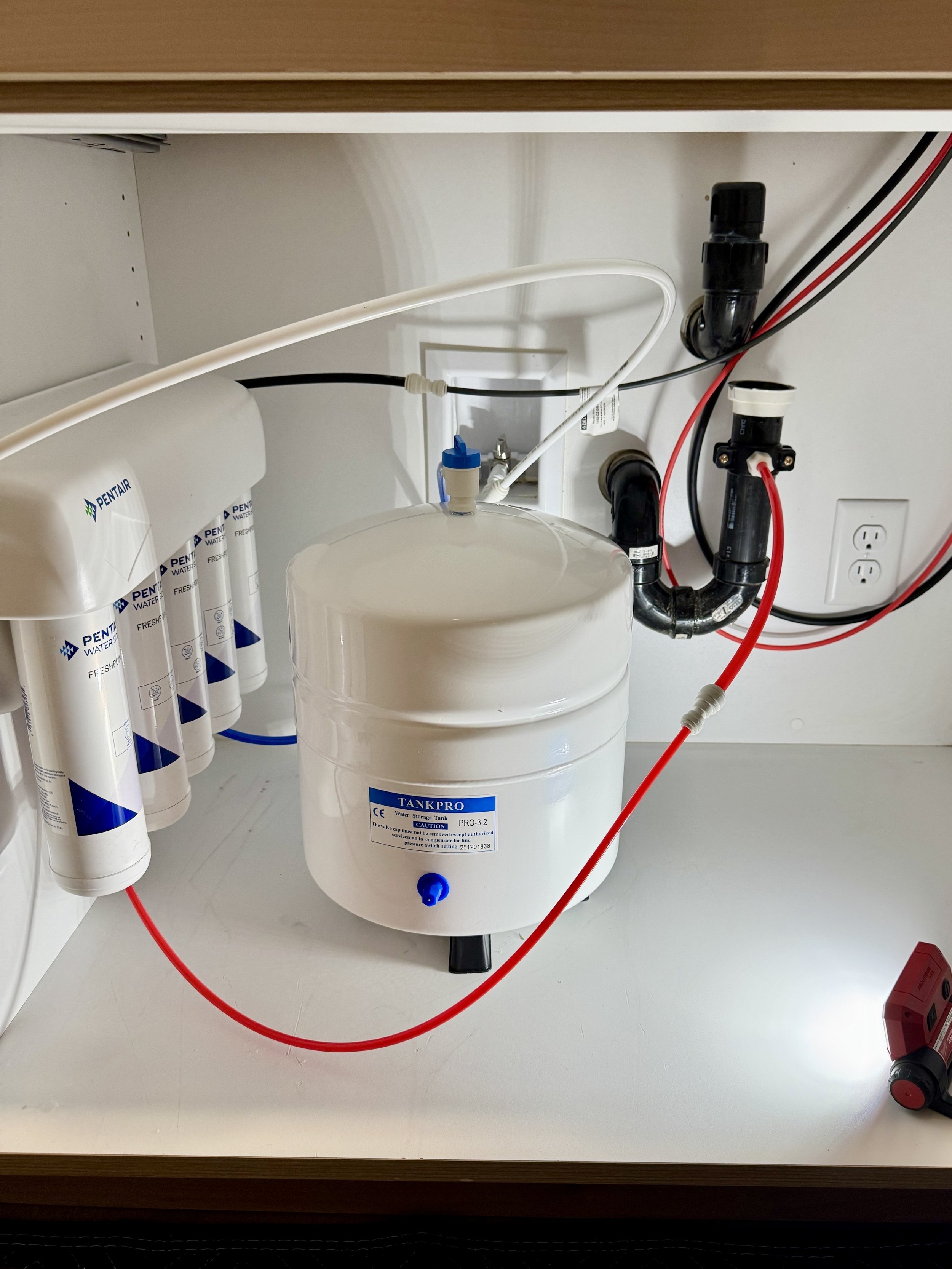
Pentair reverse osmosis drinking water system installed by Artisan Plumbing in Southern Utah.
What Do Washington County Drinking Water Reports Show?
The 2025 reports from Washington City and Ivins provide a snapshot of several commonly discussed drinking water contaminants.
Arsenic
Washington City: 1.3–3.8 ppb
Ivins: 1.0–8.5 ppb, reported as running annual averages
EPA limit: 10 ppb
Fluoride
Washington City: 0.028–0.253 ppm
Ivins: Not detected to 2.12 ppm
EPA primary limit: 4 ppm
Total Dissolved Solids
Washington City: 210–656 ppm
Ivins: 118–936 ppm
EPA secondary guideline: 500 ppm
Total Trihalomethanes
Washington City: 5–48 ppb
Ivins: 5.9–12.6 ppb
EPA limit: 80 ppb
Sources: Municipal water quality reports and EPA standards. [1, 2, 5]
These results combine measurements from different water sources and sampling locations. They do not represent the exact water quality at every household faucet.
Arsenic: How Does Southern Utah Compare?
Arsenic occurs naturally in some groundwater. Several local supplies use treatment or blending to reduce concentrations before water reaches customers. [2]
EWG's historical data provides a national comparison for 2021–2023:
St. George: 9.58 ppb
Washington City: 2.02 ppb
National utility average: 0.624 ppb
EPA legal limit: 10 ppb
EWG health guideline: 0.004 ppb
Sources: EWG and EPA. [3, 4, 5]
St. George's reported historical average was substantially higher than EWG's national utility average.
Why is EWG's guideline so much lower than EPA's limit?
EPA's enforceable standards consider health risks and treatment feasibility. EWG uses additional health-based benchmarks, including California's public health goal for arsenic.
Exceeding an EWG guideline does not automatically indicate a federal drinking water violation. [3, 5]
These comparisons reflect historical utility data, not current measurements at individual homes.
Dissolved Minerals and Hard Water
Southern Utah's mineral content is a familiar issue for homeowners.
Total dissolved solids (TDS) measure minerals, salts, and other dissolved material. Higher concentrations can affect taste and contribute to mineral deposits.
Washington City and Ivins both reported source measurements above EPA's 500 ppm secondary guideline. That guideline primarily addresses aesthetic concerns rather than a specific health risk. [1, 2, 5]
TDS alone does not indicate whether water is safe or unsafe.
Water hardness is a separate measurement associated primarily with calcium and magnesium. A water softener addresses hardness, while drinking water filtration can reduce additional dissolved substances.
Chlorine and Disinfection Byproducts
Chlorine is used to control harmful microorganisms in public drinking water.
Ivins reported chlorine concentrations of 0.1–0.4 ppm in 2025, below EPA's maximum residual disinfectant level of 4 ppm. [2, 5]
However, chlorine and other disinfectants can react with naturally occurring material in water, forming disinfection byproducts.
One group, total trihalomethanes (TTHMs), has an EPA limit of 80 ppb.
EWG's historical comparison shows:
St. George average: 35.4 ppb
National utility average: 29.1 ppb
EWG health guideline: 0.15 ppb
These figures reflect 2021–2023 testing. [3]
Disinfection serves an important public health purpose. Some homeowners nevertheless choose additional filtration for the water they drink.
Is Fluoride Added to Southern Utah's Water?
Utah prohibited adding fluoride to public drinking water beginning May 7, 2025. [6]
Fluoride can still occur naturally in groundwater.
Ivins City confirms that it does not add fluoride. Its 2025 report includes source measurements reaching 2.12 ppm. [2]
EPA's primary fluoride limit is 4 ppm, while its secondary threshold is 2 ppm.
The city's reported maximum does not mean every home receives water at that concentration. [2, 5]
PFAS and Microplastics: What Do We Know?
PFAS, often called forever chemicals, are manufactured compounds found in various consumer and industrial products.
Ivins participated in EPA's national monitoring program in 2024. Its report states that none of the 29 PFAS compounds tested were detected. Lithium was detected at concentrations reaching 180 ppb. [2]
A nondetection means a substance was not detected above the applicable reporting threshold. It does not necessarily establish absolute zero.
Microplastics remain a testing gap.
We did not identify published quantitative microplastics measurements in the municipal reports examined.
EPA's 2023–2025 national monitoring program covered 29 PFAS compounds and lithium, not microplastics. [7]
The available reports therefore cannot establish whether microplastics are present or absent in local drinking water.
What Can Southern Utah Homeowners Do?
Municipal reports provide valuable information, but they cannot establish the exact contaminant concentrations at an individual household faucet.
Homeowners can identify their water supplier, review its latest testing results, and consider testing their own drinking water.
For those interested in additional filtration, a properly selected reverse osmosis system can reduce specific contaminants and dissolved substances. The reduction capabilities depend on the system's certification and performance. [8, 9]
Reverse osmosis can supply filtered water for drinking, cooking, refrigerator dispensers, and ice makers, depending on the system's capacity and plumbing configuration.
Understanding your water gives you the information needed to decide whether additional filtration makes sense for your home.
Sources and Research Methodology
This article was researched by Artisan Plumbing using municipal drinking water reports, EPA regulations, and EWG's Tap Water Database.
Municipal comparisons use verified 2025 testing from Washington City and Ivins. St. George's national comparisons use historical 2021–2023 data.
[1] Washington City — 2025 Annual Drinking Water Quality Report
https://washingtonutah.gov/publicworks/water/ccr/CCR2025.pdf
[2] Ivins City — 2025 Water Quality Report, published June 2026
https://ivinsutah.gov/reports-studies/
Select the 2026 Water Quality Report.
[3] Environmental Working Group — St. George City Water System
https://www.ewg.org/tapwater/system.php?pws=UTAH27015
[4] Environmental Working Group — Washington City Water System
https://www.ewg.org/tapwater/system.php?pws=UTAH27021
[5] U.S. EPA — Drinking Water Regulations and Contaminants
https://www.epa.gov/sdwa/drinking-water-regulations-and-contaminants
[6] Utah Department of Environmental Quality — Fluoride in Utah's Drinking Water
https://deq.utah.gov/drinking-water/fluoride-drinking-water
[7] U.S. EPA — Fifth Unregulated Contaminant Monitoring Rule
https://www.epa.gov/dwucmr/fifth-unregulated-contaminant-monitoring-rule
[8] NSF — Reverse Osmosis Drinking Water Treatment Systems
https://www.nsf.org/knowledge-library/nsf-ansi-58-reverse-osmosis-drinking-water-treatment-systems
[9] U.S. EPA — Point-of-Use Reverse Osmosis Systems
https://www.epa.gov/watersense/point-use-reverse-osmosis-systems
Research note: Results may reflect different water sources and sampling locations. This article does not establish contaminant concentrations at individual addresses. Unresolved Hurricane arsenic measurements and unverified newer St. George measurements have been excluded.
Last reviewed: September 2026.